Out of Place

Being a communication arts student, I’ve just encountered our fifth major course—Scriptwriting for Radio and TV. Our block have just learned how to pitch ideas and put them into writing. We were also made familiar with different video techniques and audio cues, so we briefly viewed episodes of TV series or even scenes from movies to figure out such technical things. I’ve observed my classmates being so interested in TV series and/or movies that it is usually the way by which we discuss the topics we had in Scriptwriting. 

Even when it’s not Scriptwriting class, I would hear them talk about a series they were following and marathon-ing, or a movie they have just watched, and much more on the celebrities that act on those series or movies. Be it How To Get Away with Murder, or Pretty Little Liars, or Game of Thrones, or Star Wars, or Civil War, and a lot more that I’m not familiar with...And I just feel overwhelmed, alienated.

Even within the family. I think Ma and I are the odd ones out in terms of film, although we do like and prefer quality films. The rest are so into movies. Even Pa has a regular “Night at The Movies”, like what American stations have done decades ago on primetime. 

And here I am, a communication arts student who—among others who have film, or television, or advertising in their specialty—has a peculiar interest in what seems an abandoned media and will most likely work for that field someday. I am just so different, and I can’t but find myself out of place—OP.

But I surely don’t disdain everything TV and film. In fact, I have watched films and have followed TV series. I was even fascinated with a few of them.

(Clockwise) Images from the films: Dead Poets Society, Chariots of Fire,
The Pursuit of Happyness, and John Q

Feature presentations and matinees

During my summer vacation periods in high school I would watch films—not on DVD or even from a torrent file, but on HBO and Cinemax (sometimes from Star Movies too). I even subscribed to a weekly newsletter from HBO and Cinemax sent via e-mail. 

Later on, I would visit the website of both channels and browse through the movies they would broadcast. As soon as I chose a movie I would like to see (after reading the synopsis), I would take note of the schedule, and I would likely catch most of those movies. 

As long as it was vacation, movies were a part of my activities. Thanks to cable I watched movies such as Dead Poets Society, Chariots on Fire, Tron (both old and new versions), John Q, Cloudy with A Chance of Meatballs, Sucker Punch, and even Beastly and The Pursuit of Happyness. Thanks also to the movies Misery and Christine, I got more interested in reading Stephen King’s works. 


But usually I would look for vintage movies, and I would always expect them every afternoon on Cinemax. They call that segment Movie Matinee, if I’m not mistaken. On that slot I viewed various crime/spy, adventure and (mostly) science fiction films, though sometimes I found them hard to understand (especially the crime films). I was so fascinated with the science fiction flicks I saw on that timeslot—The Incredible Shrinking Man, Five Million Miles To Earth, The Blob, Earth vs. Flying Saucers, and Journey to The Far Side of the Sun

But for me the most memorable film I was delighted to watch on cable (because I’ve been wanting to) was 2001: A Space Odyssey. My father found the movie weird (mostly for the sound effects and silent scenes), though he recognized how antique it was. But I did like it at that time I picked it as my favorite movie when I was asked about it in my sophomore year.

Later in my fourth year, when the cable was converted into a digital box, I chanced upon films from My Movie Channel when it was still on air. I really liked that channel for the quality films they feature. Too bad it went off air last year, probably for lack of audience and profit. There I viewed For The Boys, The Five Heartbeats, A Christmas Carol (from the 80’s), and S1m0ne

(Clockwise) Images from the films: For The Boys, The Five Heartbeats,
S1m0ne, and A Christmas Carol (starring George Scott)


Series and sitcoms
I also got into some TV series on some cable channels. There used to be 80’s shows on 2nd Avenue when I was in my 2nd year high school which I used to follow. I would watch Small Wonder in afternoons, featuring the girl robot living with a small family. Early in the morning, there was also the stories of riding the roller-coaster ride of growing up from The Wonder Years and the young Neil Patrick Harris working as a physician in (incredibly) his teenage years in Doogie Howser, M.D. 

When AXN Beyond reformatted to beTV (which later on became Sony Channel), they aired the 90’s sitcom Everybody Loves Raymond. One time I stumbled upon it, and I liked it. I knew the schedule, and I would switch the TV to that channel at specific times (usually 5:00) and have a regular laugh from the dysfunctional family of a humorous sportswriter Ray Barone. 

When I was in third year, I also saw The Newsroom at its start. I was of course fascinated at a series about a team of anchors, journalists, and producers working for a news channel. If you ever saw an FB video of a man angrily responding to the question “Is the US still the best country in the world?” (that he said it used to be), it was from that TV drama. Later on I missed The Newsroom, and somehow I drifted away from watching TV series.

(Clockwise) Images from the sitcoms:
 Small Wonder, Everybody Loves Raymond, The Cosby Show, and Taxi


When I was yet to become a college student, I would regularly catch The Tonight Show Starring Jimmy Fallon. I would always wait for the segments, especially “Thank You Notes” and “Screengrabs”, then I either eat lunch during the interview segments or switch the TV to another channel. But often I finished the show.

The Big Bang Theory also came as another source of laughs. In the lives of four scientists with different ways and manners in their professions and their relationships, I would find myself laughing (with siblings and parents, thankfully). Even in these college years I would find it on Warner TV or Jack TV and set aside the work for a while. In such an often stressful life I’ve been living, I need a laugh. 

There’s also another good channel I’ve found from the box—Hits. It’s the place for old TV shows, and I am in for things vintage. I found doses of laughs from The Cosby Show, Different Strokes, Taxi, Married...with Children, and even Mad About You and The Golden Girls. I also viewed some episodes from Moonlighting and The X-Files. Oh, I hope I would have the time to catch The X-Files, but it appears I won’t have time for any marathon/catching-up while I was busy in the city, in the campus.

So far, aside from Big Bang, the program I catch when I have the chance, is 60 Minutes, the long-running magazine program comprised of 3 stories and the ticking of an Aristo stopwatch. 

And currently, I got hooked on Ang Probinsyano, the missions of a policeman turned CIDG officer against various criminals, especially against a drug syndicate, which makes the major plot of the story.

One favorite remains
I have shared to you my viewing list and favorite picks on television and film. Yet, this patronage fluctuates in time. But at the present, I’m less hooked on TV series or motion pictures as much as others are. 

While many I know are into today’s hero films or novel adaptations, which have just been viewed on movie theaters and probably have been released on Kick-A-- Torrent, I’m not into that. Many wait for the next episode of famous TV series on cable or online, but I’m just not interested in any of them. 

The particular reason I have felt negative about this is: I feel I won’t be able to bring anything else interesting to talk about, finding it difficult to talk at all. I feel and surmise that’s the easy link that could bring a conversation with someone, although I consider that he/she/they could give an ear on or express about other topics. And I can’t use the TV/movie link always. Or maybe I could try. Aside from that, I find it somehow ironic that I’m in a communications course, but I have less affinity to some of the trending media (except social media, of course). 

But wait, read: communication arts. The entire program involves a lot of fields (not mass media/broadcasting alone), it has a wide range of areas covered. And I just turned out to be liking the areas of radio and (a bit of) research. That’s the way it is. 

Of course, I find it helpful to view more series and films as I go through my major subjects this upcoming 2nd half of college. But I would less likely follow more than one series, or set my eyes on a lot of films. This happens to be the case because: 1) again, I like radio more, and 2) I’m a bit cautious and conservative with what I view, that’s why I grew less inclined to view films and series.

I should therefore stop being negative on feeling out of place. I have to embrace it. And maybe celebrate it. It’s nothing to be sad about. At least there’s someone who’s concerned with keeping the airwaves alive. Radio will remain my favorite. 

In fact, these past weeks and days I’ve been listening to radio dramas, book readings, and documentaries (yes, documentaries on radio) from United Kingdom’s BBC Radio 4. Maybe you would like to try them, for a change. Let me give you some links:

How I Got Into Coffee

Coffee is a part of my everyday routine, in and out of school semesters. I’m among a lot of professionals and students today who drink a cup of coffee or more everyday. Not that I go to a coffee shop every now and then and have “Adrian” signed on my cup. I’m frugal. Instead, when I’m at school, my regular cups of coffee are a hot 7-Eleven’s City Blend, a cold Nescafe French Vanilla or White Mocha, and (the main cup among them all) brewed coffee in the house. 

I thought of coffee as a bitter drink before, but as I grew up it would become a daily dose, my favorite drink aside from rootbeer.

My first coffee
My parents like coffee very much, as much as your parents do (I believe). I remember times when I was still so young when Pa and Ma tell me while we eat breakfast (or maybe evening dinner): “O, mag-kape ka...” (“Why don’t you have coffee?”) in a jokingly way. I would simply refuse. I didn’t like coffee yet at that time. But I tasted one. It was a cappuccino either my auntie or my brother got from briefly working on a night shift, if I am not mistaken. 

Later on, I happened to learn how to make coffee when either Pa or Ma called me to do it for them. I would ask how, and they would instruct me: 1 teaspoon of coffee, 1 or 2 of creamer, then 1 to 3 of sugar. I even remember Ma telling me to level the amount of either of those three on the teaspoon. But the first time I made a cup of coffee for myself was also the first time I didn’t sleep at all. 

I was in second year in high school—when academics demanded more. I was desperate to reach the deadline for lettering plates on Drafting that I turned out cramming. I have believed that coffee would make me stay awake. And with the parents asleep, and the TV on ANC, I made the coffee on my own. And it was not tasty! But what mattered was I got awake. So I went through the night trying to get those letterings done, like someone keeping a radio station on air overnight. I survived, with the help of a bitter coffee made by a once novice to that drink.

The yellow cup I usually use for the drink

3-in-1
I can’t recall any third year experience with coffee, but I do recall times when I got into drinking coffee during my fourth year in high school. Several times came when demands of school (and lack of managing time and beginning work as soon as possible) pushed me to go and finish outputs overnight. 

I remember one time when I was working (rushing, rather) on a blueprint for Civil Tech, laying out a tracing paper with bond papers containing several plans for a house. DZFE, the classical music station (which has just begun to extend its broadcasts ‘til 3am), was on the background. I took a break and made coffee. I put a sachet of a usual three-in-one coffee on a cup, filled the cup with hot water, then mixed it. And again coffee helped me get through the night. And this time it was tasty!

I hardly liked to sip a brewed coffee yet at that time. At home it was then made by boiling water on a pot, then settling it down for a while, then putting 3-5 spoons of ground coffee on that water. As a result, you likely get the remains of the ground coffee on your cup when the pot is already less than half-full. So, I would usually buy sachets—from Nescafe to Maxwell’s House. I would even carry a mug and a few sachets with me to school, and take advantage of the hot water coming from the dispenser. 

The habit of drinking coffee began to form, especially when I was done with high school and off to college.

(L-R) My mug, my mother's cup, and my father's mug.
We and our coffees gathered as we watched
UAAP Cheerleading Competition last year.

Brewed
During the longest summer vacation I got after an academic period, I have made and drunk more coffee. Later on, I learned to make and to appreciate brewed coffee on the pot. With a fresh brew on the cup or mug, I would add 2 or 3 teaspoons creamer and 2 or 3 teaspoons sugar. Since then, that’s my usual mix of coffee. But sometimes I also make a cup with instant coffee (different from 3-in-1), so I would have a teaspoon of it in the cup or mug.

With such blend, I have formed my general definition of my coffee—creamy, and sweet enough.

Coffee was with me as I ate breakfast, as I read a book or write something, and as I surf the Net. Aside from a way to get awake, it has become a way to get moving through the day. It really fits in those things I do—especially reading and writing. I don’t simply got into drinking coffee because it keeps me up, but more importantly it happened to be a great complement to my lifestyle.  

Then came the coffee machine during my first year in college, revolutionizing the way brewed coffee was made in the house. I would learn the ratio for coffee and water—1:1. Drinking coffee became more pleasant, as well as more frequent, whether I stay late at night or not. 

Others would settle on a frappe or simply iced, but I was content on a brewed blend. But sometimes I’ll have a cold version. Once I bought in a stall in the community mall, and once I’ve bought in a convenience store. But still, I’m often frugal.

In my commutes back to home,
I would often buy a cup of coffee.
Instant blend
In my second year as a college student, I further practiced that frugality. I would usually have a cup of City Blends on 7-Eleven, where I often have lunch with my closest companions. Actually, buying a coffee there secures our stay. We don’t buy our lunches on the store; we bring packed lunch. And I see it unfit that we have lunch there but won’t buy anything there. So either my classmate, I, or both of us, will buy coffee there. 

Sometimes, since there are only three choices for hot coffee, we would buy either Kopiko 78, Nescafe French Vanilla, or White Mocha. We were even glad when an Iced Coffee was added to their selections. I have no favorite among them, though. They are all the same for me, at least in what they are called. They are all good coffees, as long as taken in moderation. Besides, they less likely aid me in keeping myself up in afternoons, unfortunately. That’s because when I get back to the campus library about an hour after lunch to read (and sit back), I often end up dozing off.

Before I ride on a bus back home, I would even go to a 7-Eleven near the bus station and buy a cup (and also some food). Maybe that’s the only instance where I buy coffee to keep me awake and do something productive while I’m on the bus (as a commuter, you’ve got to have some way to save and even redeem time). This time, the coffee’s more likely to keep me awake.

Coffee is now a part of my life, and it came right before I undergo what they call “adulting”. Cups of it, or bottles, or tetra packs of it, have been with me as I struggle past academic years. 

If others got to like coffee by influence of socialization (not saying that I was totally immune from it), I got into it with an amount of “parental guidance”, as well as a liking into its self-defined taste. If others have it chilled on a tall or grande cup on a coffee shop (with details of how it is to be done), I find some joy or comfort in a hot, creamy and sweet cup from the house (or on the convenience store). But maybe, when I have the resources, I could learn discover more about this drink—beyond the usual blend. But I’m not into that for now.

I understood from a chapter of a Sociology textbook that coffee has been bringing people together in some ways I can’t instantly explain now. Yet on a personal level, I believe that coffee has been a companion—a good one, compared to other beverages. It is one of those things you grab, keep, and consume to get you through the day (like music or talk on the radio, or that portable battery-powered mini-fan on your bag). 

A record label names itself Fueled By Ramen. In my case, I may describe myself: Fueled by coffee.


How about you, reader? How long have you been a coffee drinker? And how did you get into it? Give me a comment, if you may. :)

Disclaimer: This blog isn’t any paid advertisement just because I mentioned coffee brands. :)

Life Without Internet


Source:marcusradich.com

While I was in high school I was much engrossed in science fiction, especially those under the themes of cyberspace. I chanced upon a secondhand book, a collection of short stories entitled Live Without A Net. And I bought it. The stories there center on the theme the title suggests—a future without cyberspace, without virtual reality, without the Web. And it made me think: what would happen to a world without the Internet? That seems impossible of course, but for a while I faced a dilemma similar to that. 

I remember a time during my recently-concluded 2nd year in college (first semester in particular) when I had no access to the Internet at home due to some lapses in payment, which later on turned out to be some sort of misunderstanding in how much to pay. It hasn’t been easy to be away from the World Wide Web for months, but I managed to get through it, and I learned much from the experience.

Routine
From September until the middle of November last year, there was no Internet in the house. I had to endure academic life without easy access to the Internet, so I had to find it elsewhere (and that was tedious). That meant lending saved money for it and spending spare time for it, either at the library or the computer shop. But there's no way—it seems to me—to get connected with my classmates and do most of my schoolwork but online. Besides, our aged PC is slow and broken, and I didn’t have a laptop to use for a while. And when I have had one again, there was still no Net.

So, after lunch I often extended my stay in the city for at least 2 more hours either in the library or the computer shop near the campus. Sometimes I went right away back home  and, upon arriving, went out again to one of the two computer shops I know in the neighborhood. On one of them I even had my usual seat. I brought with me my 4 GB USB, my headphones, and necessary notes, even my planner. I would try to stay online at the least possible time, but it usually went from two to three hours. Sometimes four.

At the comp shop, I usually would open Google Chrome (or Mozilla Firefox) and Microsoft Word. Often there’s music on the background, care of YouTube.

That 1st semester, I had a lot to do on Word. From research inputs for Marketing; project proposals for Broadcast Media; to scripts for a video project on Natural Science; to more researches and write-ups on Asian History and even NSTP. 

Of course, I also logged on to Facebook. Aside from scrolling the News Feed, I got information about assignments or announcements on our block’s group page. Our block's communication, when out of the class, is heavily relied online (social media in particular). 

I also contacted my classmates/groupmates there about tasks we or I had to accomplish on our projects. For instance, since I lead a part of our block—the research part of our block’s broadcast plan (our major project on Broadcast Media)—I, as my fellow leaders did, created groupchats (which I call group threads) and group pages on Facebook. There I posted announcements and pleaded them to comment a word of my choice in response to that post (for example: 'Chow!' or 'Checkmate'). We also send and gather personal outputs either on those places. Moreover, I collaborated with my fellow leaders or groupmates on Google Docs. 

On several occasions, a time would be set for the group (or the block) to show up on the groupchat on Facebook, and meet up about a major project. I even remember a time when I went back home early before traffic builds up, because I had to be online at about 6pm. No time to rest for a while upon arriving home. but on ? 

Reflection
This change in my routine was a trade-off, a sacrifice. Instead of commuting back home after lunch
and do schoolwork at home (as planned), I would go to the library or the shop the whole afternoon. Sometimes I would reach evening, and I reached home at around 7 to 9pm. Or when I would go home then out again to a shop, I returned home at around the same times. In fact, instead of having money saved for Christmas, I had to sacrifice it to accomplish necessary work online. It seems that everything’s online. 

A college student doing much research, paperwork, and group work, the World Wide Web was a necessary resource for finding and gathering information, producing outputs, and connecting and communicating with people.

Maybe I’m so late to state, but indeed times have changed. This is a time where the generation of people—I included—are living with the Internet as necessary as the radio in the 20th century or the cellphone at the present. It has become the primary means of connection and a source of information (aside from the library) these times. Internet has already been an essential for students!

It’s been considered a tremendous and valuable resource these days. It shouldn’t be ignored, however, that the library is also an essential for a student, especially in research. (I even consider it’s contents like treasures in a mine) Yet the sources of Internet are necessary to be integrated with whatever you find in a library, because the Internet has much recent material, be it articles, and even video and audio clips.

Unless anything else gets you busy, the Internet is even the stuff of the day, usually on rainy and stormy days. Isn't it good to be in the house during the typhoon, just to stay dry and safe? You even have the extra time to finish remaining loads of schoolwork. But now, without the Internet, living the day appears to be almost boring! And the day is almost lost in direction, unless you have come up with things to get you busy again. If there was only the zeal to read the book, or a station similar to UK’s BBC Radio 4...

Result
Apparently, I did miss the Internet very much. But I’m thankful that this sort of sacrifice I did for a large part of my 1st sem paid off. I passed and survived the sem, earning a harvest that I should be thankful for. Besides, it seems that at the end of every sem, what matters is that you’ve survived.

I was also glad the Internet was accessible again at the comforts of the home before the semester ended, just in time for the semester’s most pressing outputs I had to accomplish (and cram, sadly) with my classmates numerous kilometers away. The Internet provider was replaced, and I find the service efficient enough.

Sometimes we have to face such challenges. In these kind of circumstances we learn to make ways and take alternatives. It’s like the rats in a maze searching for cheese around the different parts of the maze when the cheese in one part was gone. Besides, it helps to take a break from the Net once in a while—even more than that.

The current challenge for me, now as I have been accessing the Internet, has been to manage the time and content I consume online. Why? Sometimes, going online gets you nowhere, letting time pass away without any productivity. Here is another struggle, and it is real.

You reader, have you ever had that experience of having to find Internet access away from home? How would you face a day (or more) without the Internet? I want to hear from you. 

15 Songs from 2015 That I Like

Another year will close, and so another one opens. One of the few things I could highlight in this year is that despite my flair for retro music and almost-dislike for pop music, I still find good songs from today's music, be it a chart-topper or not. In no particular order, let me share some (if not only this 15) songs from 2015 that I like. The songs, by the way, are not in a particular order. 

1. Into Your Arms | Capital Kings


2. Beautiful Now | Zedd feat. Jon Bellion


3. Verge | Owl City feat. Aloe Blacc


4. Desire (Gryffin Remix) | Years & Years


5. Run Away With Me | Carly Rae Jepsen


6. Confident | Demi Lovato


7. How Deep Is Your Love | Calvin Harris & Disciples


8. Drag Me Down | One Direction


9. Run | AWOLNATION


10. Shots | Imagine Dragons


11. Where The Sky Hangs | Passion Pit


12. Orphan | Toto


13. Stockholm Syndrome | One Direction


14. Style | Taylor Swift


15. Unbelievable | Owl City feat. Hanson


How about you? What songs do you like from 2015? And which from this list do you like as well? Give me a comment, or a tweet, would you?

A blessed 2016 ahead for you!

Another Appointment with Books


I'm done with another first semester, and it left papers as a remembrance now filed into their respective envelopes. Not only does first sem's end mean I can finally give myself much rest. For me, it also means cleaning my small room, its shelves, and books. 

It's been a usual thing to do during free time, and I'd been waiting to clean my room and revisit my books. It was another time for me to decide which to keep, and which to "phase out". Yet, what seems to be a once-a-day job before extended to at least three days! I started late in the morning with cleaning the dust off the shelves, but I found it difficult to accomplish attending to my books for a day. But at least, I started!


I cleared the shelves, taking the books out of their nooks one by one. These books stayed stacked in the different corners and spaces of the almost-skimpy home: at the living room, at my desk (on top and under), and at my room.

After I cleaned my shelves, I started cleaning the books I placed at the living room. Next, I headed to the desk and cleared the top desk first, stacked with both pocketbooks and hardbounds (and also a softbound). 


Few days passed before I got to attend to the rest of my stacks of books. So there were much books left piled up like prototype buildings.


When I got back to my books two days after, there was much which I decided to let go—phase out, in other words. But there was much I wanted to keep, and I did, especially the YA ones. And with that comes somehow a promise to get back to them and finally read them. I hope.


NSTP DRRM Seminar: Addressing the Nation's Disaster Issues by Involving Communities and Youth

In the efforts of UST’s National Service Training Program to raise the youth’s awareness about national issues involving disasters and to empower them to be part of the solution, a Disaster Risk Reduction Management (DRRM) seminar was held, which I attended last October 25, 2015. Very timely and relevant for us to learn from, the seminar has been an orientation not only to the natural disasters our nation faces and how we should respond to them, but also to the issues they raise and what we should learn from them. 

Understanding DRRM and its related concepts

A big part of this seminar focused on the concepts surrounding disaster risk reduction and management (such as disaster, hazards, and risk) and how each differs from the others. 

Here I understood that disasters are not necessarily all about the events; they may be a result of human activities as well. While hazard brings the potential to cause disruption or damage (whether natural, human-induced, or environmental), risk is the consequence that may arise once hazard interacts with vulnerable areas. I have also found out that as communities face hazards, we must consider the vulnerabilities that hinder the ability of a community, as well as the capacities that can enhance their ability to face and cope with disasters. It is important for us to determine these vulnerabilities and appreciate our capacities when dealing with uncontrollable hazards. In spite of these, disaster risk reduction and management comes to decrease the community’s vulnerabilities and increase its capacities, towards mitigating and managing risks so that disasters in the community may lessen—if not entirely eradicated.

If the community, then, would move towards risk reduction and management as well as disaster resilience, working together is essential. However, as I have learned from the lecture, the norm was a top-down approach--in summary, higher authorities respond first and even only after the onslaught of calamities. 

At the present, thankfully, a paradigm shift led to the current approach to disasters, and it enjoins the members of the community into participation with authorities. 

And, I see, this is why we in that seminar, as citizens of this state and as members of our own communities, were taught these things that afternoon.

Employing the knowledge

While everyone of us there were much informed by the lecture, we put and furthered our learning into the exercises given to us by our facilitator. Each group in our section did our Participatory Capacities and Vulnerabilities Assessment. Each of us in our group contributed our own places to the assessment, and we also determined the problems we think each of our barangays were dealing with, the vulnerabilities that likely seen in the residents, the capacities that possibly lie within each of them, and the actions they as a community can do in order to address vulnerabilities and build up capacities.


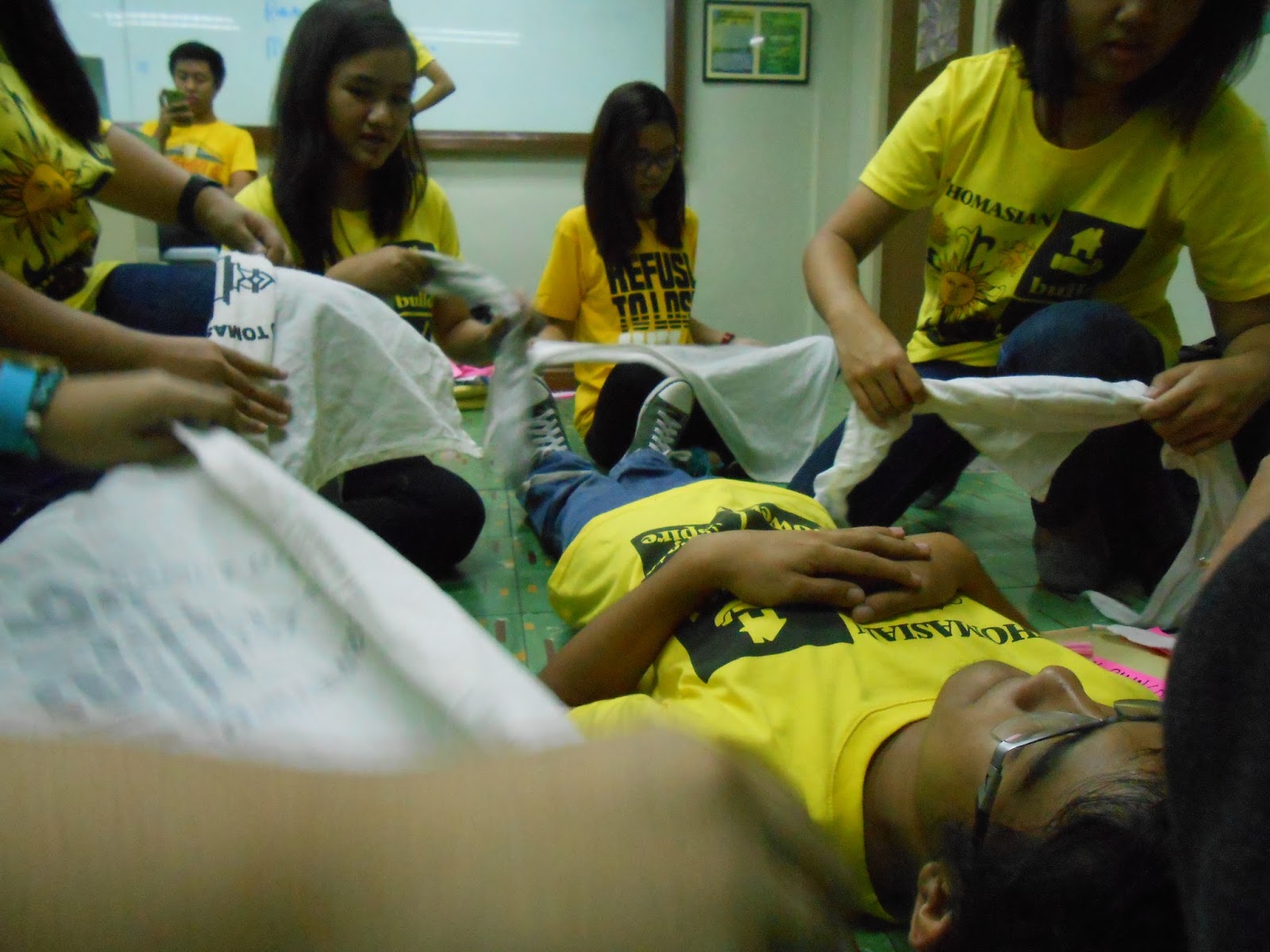
Aside from the assessment, we were also trained about first aid and basic life support. I believe I need to recall such knowledge to my mind, even if I was oriented to these things when I was in high school. I cannot learn them at an instant; I might have to learn them over and over again, even now.


The blogger volunteered to be the patient whom his groupmates would try the first aid procedured on


A certain carry technique being performed by the rest of the group


Reflecting on these lectures and exercises, I have seen how beneficial it is when members of the community collectively harness their knowledge and skills to prepare for any disaster in the future that can make them prone to tragic consequences if they do otherwise.

Personally, I was reminded that day that there are disasters around us, even way beyond natural; and it’s beneficial therefore to determine how vulnerable we are to these "disasters" and believe in what we can do to overcome them and avoid them.

Actual application and action

How is disaster risk reduction management actually applied by a community? I got a glance of it at a barangay near my home—Barangay Balibago in Santa Rosa, Laguna.

I was able to meet and talk to Brgy. Kagawad Michelle T. Catindig, committee chairman for health and sanitation. Regardless of her expertise, she exerted effort to impart to me the barangay’s efforts in conducting disaster risk reduction and management. In particular, she presented to me the plans, as well as a report of how DRRM has been performed.


The barangay hall has a copy of this guide about disaster management provided by the city government

Barangay Balibago has a Barangay Disaster Risk Reduction Council (BDRRC) which sets and carries out a Disaster Preparedness and Management Plan for the barangay, and also is in charge of the activities relevant to disaster preparedness, rehabilitation, relief, etc. The barangay’s plan centers, as Kgg. Catindig explained, on its objectives as its framework. As far as I can recall, she emphasized the objectives as the reasons why a Preparedness and Management Plan exists for the barangay, which are: “to save lives, to prevent needless suffering, to protect and to minimize damages during disasters and calamities”. 

 Clippings of the Brgy. Balibago's Calamities and Disaster Preparedness Plan

With the plan working toward reaching these objectives, it lays out the BDRRMC, its organization into several officers and teams, and its tasks for its Chairman and Service Team Leaders. Furthermore, the plan essentially details coordinating instructions for the council and—more importantly—implementing guidelines before, during, and after the impact of a disaster.

As far as actual action is concerned, in its State of the Barangay in the 2nd semester of 2014, Brgy. Balibago’s Sangguniang Barangay affirms its commitment to be fully-prepared for the onslaught of calamities in order to meet the needs of affected constituents and prevent large-scale effect in the communities. The barangay has secured rescue and disaster equipment and also conducted a seminar in disaster preparedness & rescue operation for the barangay's tanods. 


Also, July 17, 2015, with Typhoon Glenda bringing much damage to the barangay, from collapsed posts to torn roofs, the Sangguniang Barangay, together with other officials, urgently responded by conducting a clearing operation.


In a personal scale: Addressing vulnerabilities, increasing capabilities

As previously seen, not only government units are being oriented to take action, but now communities as well are involved  towards reducing and managing disaster-borne risks and the issues they carry with.

And in a personal scale, what I think I could do to address vulnerabilities and increase capabilities of my community begins with having more care and awareness about the community, its vulnerabilities (and even my own), perhaps why they are there, and how they remain there. Then, I would like to follow it up with prayer.

I might as well talk to people among the community whom I know (especially in our church) and discuss such issues. If they become fruitful, we might as well join our hands in laying out our concerns to the authorities. 

Moreover, if ever I have the specific knowledge that is applicable to dealing with the vulnerabilities, I should impart that knowledge. I might as well avoid being an additional vulnerability. 

To increase the capacities, I should consider bringing the knowledge and skills of the community to a higher level. This again has to do with imparting knowledge, which can be done (most likely in partnership with groups/the LGUs) through teaching the members about what we should brace ourselves for and how we should do so.

In a larger scale: Dealing with pressing disaster issues

Along with the regular natural occurrences our country experiences, the Philippines is physically surrounded by features that are potential to induce risk. In fact, we have already encountered these phenomena throughout history, and we have witnessed properties destroyed and lives lost out of them. This is a clear reason for us to address the issue of disasters. After the catastrophes we have gone through (such as Typhoon Yolanda and the Bohol earthquake), our country, as a nation that is mandated to protect and foster the welfare of its people and communities, cannot—and shouldn’t—afford another large aftermath of casualties.

The best time to address such issues is now, although in reality there are much issues facing us. Yet, may our officials—from national to local government (especially the next ones)—never neglect to allot time in dealing with these issues. 

Any time is the best time to address these issues, but we hope now they are addressing it. 

While the executive government should initiate in addressing these issues, agencies such as, the Philippine Atmospheric, Geophysiscal, and Astronomical Services Administration (PAGASA), Philippine Institute of Volcanology and Seismology (PHIVOLCS) are the ones who will help a lot in providing essential information. More importantly, the National Disaster Risk Reduction and Management Council takes action in addressing DRRM issues, initiating preparations and keeping the situation under control. 

Of equal importance, leaders of local government units (LGUs) and heads of communities, including those trained, immersed, and highly-educated in disaster risk reduction management, are the people who would matter a lot in marshaling their constituents so that concerned individuals themselves might be a part as well of the solution.

And this at least has been done through the efforts of UST’s NSTP in enlightening us with the pressing issues about DRRM, and imparting us with knowledge as to how to prepare and deal with disasters and its effects. 

We have the power as members of our communities to do our share in this matter, and I hope I do mine in any way I could.
———
Photo credits: Brgy. Balibago's Ulat sa Barangay, 2nd Semester 2014, October 4, 2014 (Powerpoint presentation)