I came down from a bus one Wednesday afternoon, arriving in Walter Mart here in Santa Rosa, Laguna right from Manila. As usual, I welcomed the coldness of the small mall, walked on the clean, white-tiled floor, and went right away to my favorite place there—Booksale.
I did my usual peeking into the shelves. I started amusing myself with the books at the front (which are mostly Christian literature). I continued with looking into the pocketbooks at the box beside the shelves. Then, I entered inside the stall, towards the books inside a skimpy spot there, where I bent my knees to see the spines of those books piled together at one side. These have been the usual things I do whenever I arrive at Walter—to look into Booksale, to saunter and take a break inside that secondhand bookstore.
Even a cashier there has known me for a long time. We usually converse, and at those times—of course—he begins the talking. But at that particular time, he informed me of something that I almost thought of before: the bookstore will pack up and close. This month will be their last, and maybe at the time this is published it is clearing up its area.
The Booksale in Walter Mart is the nearest I could get to a bookstore, but sooner it would not be anymore. I just have to take a tricycle or two, then a jeep to the nearest Booksale, in SM Santa Rosa. The cashier and I will most likely get to see there once I no longer see the Booksale in Walter.
I will do miss that place. I don't know if another store will replace it, though that would be good. But I will miss it for one simple reason: It was my sanctuary. It's the place where I encountered and bought books on my own for the first time, thanks to my commuting as a high school student.
It was there where an interest in books bloomed, and sprouted out. I remember the first books I purchased there—three Reader's Digest condensed books (which I haven't completed yet!), and the first books I purchased and finished—a non-fiction about former US President Jimmy Carter. Since then, I have bought a lot of books there; until I realized I cannot read them all anymore, mostly due to my 1) decreasing interest in science fiction, 2) my increasing interest in Christian literature, and 3) my lack of willingness to read what I bought and to control how many I buy.
And out of this interest in books, combined with inclination to newspapers and inspiration from authors and people around me, I gained an interest in writing.
Booksale, this bookstore that offers good finds (if you're willing to "hunt") for very affordable prices, has been a part of my adolescence, and—at the risk of sounding corny—my life.
So long, Booksale. Thanks, and see you in SM and—hopefully—in Times Plaza (at UN Ave.) and Mall of Asia.
What Does A Like Mean?
In these times where the the World Wide Web—particularly the social media—is the main medium, Facebook's news feed is our most accessible newspaper. The News Feed has become one of our windows to what's happening or has happened within our circles (family and relatives, friends, communities) and around the world.
With our scrolling (which often becomes too tedious), we see a plethora of posts, either they may be statuses, photos, or links. And along with these posts, Facebook introduced us to three functions we could use to respond to posts and to reactions to those posts, as well as to see whether our posts are well-received or not. These are the like, the comment, and the share. Among these three, the like is what Facebook is mostly known for; it even has taken its place on contemporary language and culture.
But what does a like mean these days? As I have observed in my daily practice of logging on to Facebook, that blue "thumbs-up" hand means more than a like.
In the first place, a like is an appreciation of a post. We click that thumbs-up because we're delighted, amused, or entertained about it. Now, a like may also mean we understand the situation happening in an area. A like may heighten the interest in posts about stories "of national interest". A like may also mean an affirmation of our awareness of a cause raised through a post.
A like may mean that we're with the one who posted about a certain plight of him or groups affiliated with him. And for anyone who shares something out of his/her heart in a lengthy post, a like may bring comfort. At least, depending on the depth of our relationship with that sharer, we know what's going through with him/her. And so we're with him/her.
Aside from those, especially in these times when anyone can be reached out a fingertip away, a like may mean that some announcement addressed to us is "Noted." It's a sign that we really received the message, not that we've just "seen" it.
A like may also mean that a post has served as a reminder for the one who liked it. I usually do that, just in case I need to go back to that notable quote or Bible verse; because I thought of doing so for the purpose of returning to it, like notes in a class. However, I have rarely return to them.
The blue thumbs-up icon named like has meant much in this age of advanced and advancing ways of communication. The symbol has much meaning, but this meaning actually depends on how the viewer uses or receives it.
But the like isn't only the Facebook function that is dynamic. Shares and comments mean a lot too, and I think they mean better than likes do. An online news satire series notes it very suitably: "Higit sa like, share!" (More than liking it, share it!)
(But pardon me, I haven't shared an episode of that show yet!)
So, what do you think? Do you have other definitions of 'like'? Have your say and give a comment!
![]() |
| Image credit: personneltoday.com |
With our scrolling (which often becomes too tedious), we see a plethora of posts, either they may be statuses, photos, or links. And along with these posts, Facebook introduced us to three functions we could use to respond to posts and to reactions to those posts, as well as to see whether our posts are well-received or not. These are the like, the comment, and the share. Among these three, the like is what Facebook is mostly known for; it even has taken its place on contemporary language and culture.
But what does a like mean these days? As I have observed in my daily practice of logging on to Facebook, that blue "thumbs-up" hand means more than a like.
In the first place, a like is an appreciation of a post. We click that thumbs-up because we're delighted, amused, or entertained about it. Now, a like may also mean we understand the situation happening in an area. A like may heighten the interest in posts about stories "of national interest". A like may also mean an affirmation of our awareness of a cause raised through a post.
A like may mean that we're with the one who posted about a certain plight of him or groups affiliated with him. And for anyone who shares something out of his/her heart in a lengthy post, a like may bring comfort. At least, depending on the depth of our relationship with that sharer, we know what's going through with him/her. And so we're with him/her.
Aside from those, especially in these times when anyone can be reached out a fingertip away, a like may mean that some announcement addressed to us is "Noted." It's a sign that we really received the message, not that we've just "seen" it.
A like may also mean that a post has served as a reminder for the one who liked it. I usually do that, just in case I need to go back to that notable quote or Bible verse; because I thought of doing so for the purpose of returning to it, like notes in a class. However, I have rarely return to them.
The blue thumbs-up icon named like has meant much in this age of advanced and advancing ways of communication. The symbol has much meaning, but this meaning actually depends on how the viewer uses or receives it.
But the like isn't only the Facebook function that is dynamic. Shares and comments mean a lot too, and I think they mean better than likes do. An online news satire series notes it very suitably: "Higit sa like, share!" (More than liking it, share it!)
(But pardon me, I haven't shared an episode of that show yet!)
So, what do you think? Do you have other definitions of 'like'? Have your say and give a comment!
How To Watch The News
| From: www.hardrainproject.com |
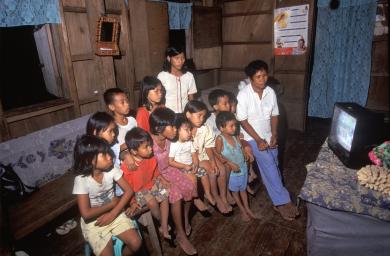
Watching the news is one of the activities that keep us informed and in touch with the world around us. Aside from primetime dramas and sporting events, television newscasts most probably huddle people (particularly families) together while they eat their dinner, have their coffee, etc. Newscasts, as I see them, are a part of our culture that generations can be classified by those who grew up watching RPN 9's Newswatch and those who identify with Noli de Castro's "Ti-veeeeeeeey Patrol!". From breakfast to dinner, and even before bedtime, television newscasts accompany us.
![]() |
| From: drnorth.wordpress.com |
I've observed, somehow, that when it comes to watching news—especially when we're with other people—it seems that we're responding to the news instead of listening to the news. I think an ethics in watching the news is helpful for such a circumstance, especially with respect to concerned and socially-aware individuals who want to know know and then digest the news.
My suggestions are plain simple:
1. Listen to the news
Keep quiet. Be silent when watching the news. Listening to the report is as much important as watching it. How could we (and others with us) understand the issue or report when anyone of us instantly blurt out our personal comments? Worse, the news item is just being introduced, the headline is just being read, and yet we comment instantly (and sometimes the newscasters do).
We don't know the details yet at that time, so we better know the story in full. Keep the comments to yourself. Leave it for later. No wonder commentaries (if there are any) are placed before the newscast ends. Check out TV Patrol or The World Tonight for what I mean.
And thankfully there are commercial breaks. Probably that's a good time to let the comments out, and hopefully for a discussion surrounding that comment begin.
Just to reiterate the aforementioned ethic,
![]() |
| From: sofrep.com |
2. Pay attention
Just pay attention. Let the newscaster talk to you. Let the reporter give you the details. They are dedicated to informing you about what their newsroom thinks is important for you to know, and they are paid for that. So, let them speak.
Don't crowd the noise made by news by other noises from comments. Sometimes, though, reactions are unavoidable. But after that, may we hush and pay attention?
And lastly,
3. Application of rules 1 and 2 depends on the items
In other words, discern what you will pay attention to and digest.
It depends on you, but I really hope you will pay attention to what's really important for you to know. News services are there to tell us what we need to know, but one way or another that isn't followed. So, choose a good source.
Following such ethics is not easy to do. It is, I believe, a habit for us to develop. Even I tend and have reacted and commented instead of listening to the details. But as much as I can, I stay put to know the news, that I may digest them and make sense of them as an individual living with other individuals who are as much affected by such news as I am, although probably in different degrees.
It has taken a blog post to tell you simple things. And this time I will type them for you to remember: Listen to the news. Pay attention. Digest thereafter. Comment later.
———
What do you think? Do you agree? Give a comment, if you may.
Subscribe to:
Posts (Atom)